Sound surrounds us every moment — in music, speech, and nature. But what’s the science behind it? This guide explains clearly how does sound travel through air, how it begins, and what affects its movement.
What Is Sound and How It Travels Through Air
Before understanding how does sound travel through air, it helps to know what sound actually is. Sound is a form of energy created by vibration. When an object vibrates, it disturbs the air around it, forming pressure waves that move outward.
The Nature of Sound
Sound waves have several key features:
- Pitch: Determines whether a sound is high or low.
- Volume: Measures how loud a sound feels.
- Frequency: The number of vibrations per second.
- Wavelength: The distance between two wave peaks.
These characteristics shape how sound moves and how we hear it.
The Science Behind How Does Sound Travel Through Air
Air is a mixture of moving molecules. When something vibrates — like a speaker or guitar string — it pushes air molecules together and pulls them apart, creating compressions and rarefactions. These pressure variations form longitudinal waves, the scientific basis of how sound travels through air.
Air Molecules and Sound Movement
Each air molecule transfers its vibration to the next one. This chain reaction spreads outward, carrying the sound energy through the air until it reaches your ears.
How Fast Does Sound Travel Through Air
Sound does not travel instantly. Its speed depends on several factors. At room temperature (20°C or 68°F), sound travels through air at about 343 meters per second or 1,125 feet per second.
Key factors influencing this include:
- Temperature: Warm air increases molecular motion, speeding sound up.
- Humidity: Moist air makes sound move slightly faster.
- Density: Denser air slows sound down a bit.
Comparing Sound Travel in Air, Water, and Solids
To understand how sound travels through air, it helps to compare it with other materials. In solids, molecules are packed tightly, so vibrations transfer quickly. In liquids, they’re more spread out, slowing sound slightly. In air, molecules are farthest apart, so sound moves slowest.
Approximate speeds:
- Solids: ~5,000 m/s
- Liquids: ~1,500 m/s
- Air: ~343 m/s
How Does Sound Travel Through Air to Reach Our Ears
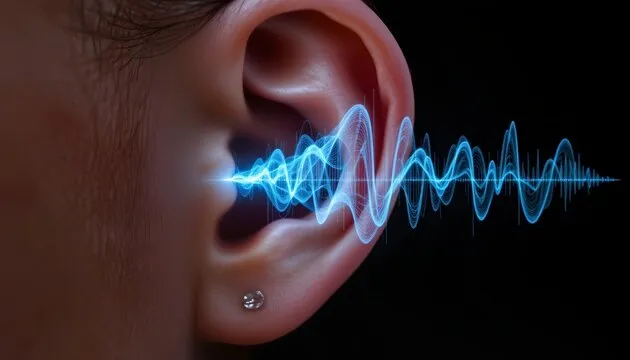
The hearing process shows exactly how does sound travel through air. Sound waves enter the ear canal, vibrating the eardrum. These vibrations move through three tiny bones in the middle ear and reach the cochlea. The cochlea converts vibrations into electrical signals that your brain recognizes as sound.
Factors That Affect How Sound Travels Through Air
Several elements influence how sound travels through air, including:
Temperature
Warm air allows faster sound movement, while cold air slows it down. That’s why sounds travel better on warm days.
Wind
Wind can carry sound farther when blowing in the same direction, or weaken it when blowing against it.
Humidity
More moisture in the air slightly increases sound speed since water vapor is lighter than dry air.
Obstacles
Walls, buildings, and trees can absorb, reflect, or scatter sound waves, reducing how far sound can travel.
Practical Examples of How Does Sound Travel Through Air
Knowledge of how does sound travel through air is used in many fields:
- Communication: Phones and speakers rely on air vibration.
- Medicine: Ultrasound uses sound waves for imaging.
- Safety: Sirens and alarms work through air sound propagation.
- Music: Concert halls are designed to enhance air acoustics.
Myths and Facts About How Sound Travels Through Air
Let’s clear some common misunderstandings:
- ❌ Myth: Sound can travel in space.
✅ Fact: Space has no air molecules, so sound cannot move there. - ❌ Myth: Louder sounds travel faster.
✅ Fact: Sound speed depends on air temperature, not loudness. - ❌ Myth: Sound only moves straight.
✅ Fact: Sound waves can bend, reflect, and spread in multiple directions.
Experiments to Understand How Does Sound Travel Through Air
Try these simple experiments to visualize how sound travels through air:
- Clap your hands in an empty room to hear echoes.
- Tap a metal rod to compare how sound moves in air versus solid material.
- Speak through a paper tube and notice how clearly the sound travels.
Conclusion
Understanding how sound travels through air combines physics, biology, and environmental science. Sound is a vibration that moves through air molecules as longitudinal waves. Factors such as temperature, humidity, and obstacles affect the speed and quality of sound. This knowledge not only helps in daily communication but also informs technology, safety, and entertainment.
By studying sound travel, we appreciate the invisible yet powerful way vibrations connect the world around us. Next time you hear a bird singing or a car honking, remember the journey of sound through air that makes it possible.
Frequently Asked Questions (FAQ)
1. What causes sound to travel through air?
Sound travels through air when vibrating objects cause air molecules to move. These vibrations form waves that carry sound energy to our ears.
2. Why can’t sound travel in space?
Space has no air or any other medium for molecules to vibrate in. Since sound needs a medium like air, it cannot travel in a vacuum.
3. How fast does sound travel through air?
At room temperature (20°C or 68°F), sound travels at about 343 meters per second (1,125 feet per second). Warmer air makes it travel even faster.
4. Does sound travel better in humid air?
Yes. Moist air contains water vapor, which makes it slightly less dense. This allows sound waves to move more easily compared to dry air.
5. Why do we hear echoes?
Echoes happen when sound waves reflect off hard surfaces like walls or mountains and travel back to your ears after a short delay.
6. How does wind affect sound travel through air?
When wind blows in the same direction as the sound, it helps the sound waves travel farther. When blowing against it, it reduces the distance sound can travel.
7. Can temperature affect sound speed?
Absolutely. In warmer air, molecules move faster, allowing sound to travel more quickly. In cold air, sound slows down.
8. What type of wave is sound in air?
Sound in air is a longitudinal wave, meaning air molecules vibrate parallel to the direction in which the wave travels.